“We didn’t come to Europe to get beaten, insulted and imprisoned.”
In September 26th, 2013 the new so called “first reception center
(KEPY)” opened in Moria on the island of Lesvos. It is the second of its
kind in Greece following the example of the KEPY in Fylakio, Evros that
opened earlier in the same year.
The Pagani of the Troika – as it is called to remind of former prisons
and to disconnect it from nearby Moria village, is a prison where only a
few selected NGOs have access under the precondition not to share any
information with the outside world. Civil society gets presented the
term ‘first reception’ that gives a false impression of an open,
accessible place while it is nothing else than another new prison in the
tradition of Amigdaleza’s fenced containers the only difference being
the detention duration – at first sight. As prescribed by law, detention
does not exceed 25 days maximum in this place BUT detainees might just
be transferred to (pre-removal) detention centers such as Fylakio,
Komotini, Xanthi or Chios for example, where they might stay up to 18
months or more if they are not readmitted to Turkey, deported or sign
voluntary return in the meanwhile.
Currently the detention center in Moria is being constructed directly
next to the “first reception” center, and build within the same fences
and with the same containers. It is about to be opened in beginning of
July 2014 with a capacity of 750 people while the capacity of the “first
reception” screening center is supposed to reach 250 places.
Nonetheless, only detention is what has marked the character of Moria
since the beginning.

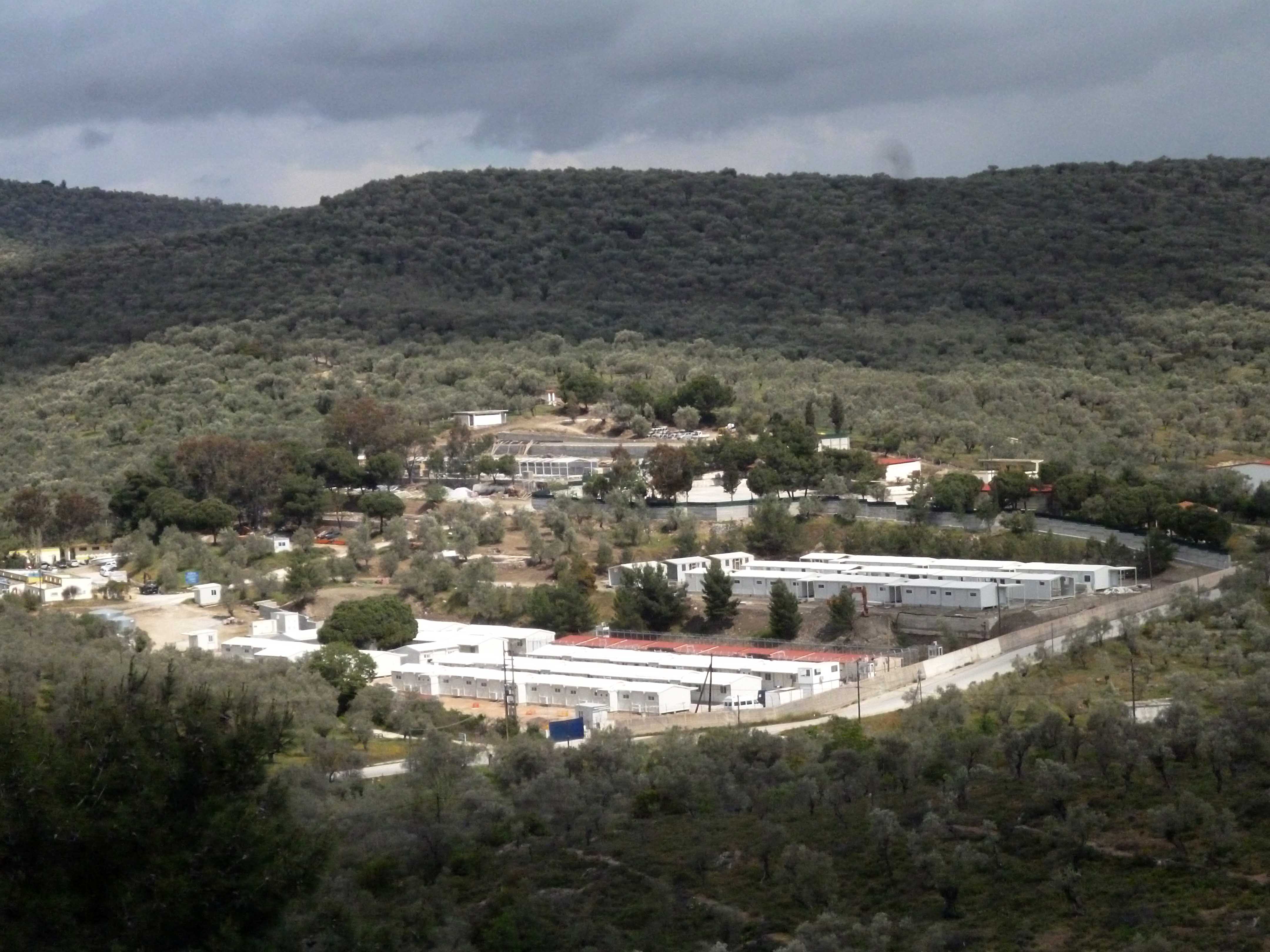
Moria in April 2014 while the construction of the fences was not yet finished
It is our aim to show from the very beginning of its functioning the
real face of the ‘first reception’ detention center and to insist that
this has to be closed. We do not argue for better detention conditions
but for freedom!
We asked refugees having passed through Moria prison one single question:
‘What was your worst experience inside Moria detention?’
The Syrian who was hit
He was a newcomer. He came from war in Syria. He had no information
on how the camp functions. Three times a day the police called all the
people to stand in a line in order to count us. At 14.30 to 15 o’clock,
all the people had to stand and the police counted. No one was allowed
to be missing. When the police entered the container they found him
sleeping. One policeman pulled him from the bed, screamed at him and hit
him. This guy just didn’t know he had to go out for counting. No one
had told him, so he was not guilty. It was not his fault.
Seeking democracy and finding police
When we migrate to Europe we are in search of democracy seeking
humanity. We don’t come here to be insulted or treated in badly as if we
were guilty or criminals. We have enough of this in our countries:
Enough worries, enough dictators, enough people who suffer and enough
bad people hitting us.
All of us, who were in the camp at that day, didn’t get food because
they were angry about why we were brought there. What we heard about
Europe is one thing, and what we face is another thing. The first thing
we had to face here was this policeman… But when we got free then we met
all these nice people! Wow! Very kind people and very generous people.
What we expected, we finally found it!
The man who fell from the bed
He was a short man and the upper bed was high. There was no ladder to
climb up. There were no ladders at all in this prison for the beds.
Only the first
10 days we had some. Then they took them all off.
His friends had to help him to get on his bed. One night when the
policeman shouted us to come to count us, he was asleep. He wanted to
get down fast because he was scared that the policeman would hit him, if
he wouldn’t be fast in the queue. So he fell down from the bed. For one
moment, he didn’t know where he was, because he got so scared in his
sleep hearing the policeman scream. He hurt his leg and his back. An old
problem he had on his back got worse after that. He told the doctor who
said he shouldn’t worry, but still his back hurts. We asked the
policemen why they took the ladders away. They said: “So that you don’t
escape.”
No shoes
The worst thing in Moria was that I had no shoes. I always asked for shoes but nobody gave me some.
No freedom
Each day of the 25 days in there was horrible for us because we had no freedom. These policemen were all the time disturbing us.
No protection
When the officer hit the Syrian we got scared seeing that such a
thing is possible in Europe. In our countries we had learned that Europe
is the mother of freedom but we had to understand that there is no
protection for us even here. We didn’t come to Europe to be hit,
insulted, to be slaves or prisoners.
Greek Guantanamo
The first day we were brought to this prison we were ordered to sit
on the ground in a line. The officers forbid us to talk. It was like in
Guatanamo. We were prisoners. In there things happen that are not right.
The long walk and standing in the queue
For me the worse was when we walked upon arriving on Lesvos all the
way until Moria. No one arrested us to bring us to prison. We had to
come ourselves after an exhausting journey.
Inside Moria the worst thing was that they ordered us to stand in a line
and punished the ones who didn’t come immediately by not giving them
food.
Punishment for praying: no food
When I was once praying and as I finished I went to the queue, but
the policeman told me to get out. Everyone got food apart from me. The
officer said to me: “You don’t get food today!” On that day I didn’t eat
anything.
Prisoners not refugees
The policeman called me to translate for the ones who couldn’t speak
neither English nor Greek. He started: “Tell the prisoners…” but before
he finished his sentence, I interrupted him, saying: “Excuse me, but we
are not prisoners, we are refugees who just arrived from Turkey. We are
not prisoners!” The policeman replied: “You are not refugees you are
prisoners! Now translate and don’t talk.”
Not allowed to take medicine
When I was in Moria I couldn’t sleep at all. I had problems. I told
it to the doctor and she gave me some pills to sleep. At that point I
hadn’t slept for four days. The pills helped me finally sleep.
One day I was still sleeping when the policeman came. He said: “If you
don’t come on time I will make problems for you.” He forbade me to use
the pills again that had helped me to sleep.
When the doctor later asked me how it was going with the pills I told
him that I couldn’t use them because the policeman forbid it to me.
Punishment: no electricity
One young boy went out of his container to sit and smoke. The
policeman yelled at him to go inside otherwise they would cut the
electricity. Then they cut the electricity.
They also cut the electricity of the Syrian woman and minors who were on
hunger strike, because they were kept in detention so long despite
being Syrians.
Prisoners
In the bathroom there is a sign that says: The ‘prisoners’ ….
Changing rooms
We were in the same room for 23 days. We kept it clean and lived in there.
One day at one o’clock at night they made us change the room, saying new
Afghans came and we should go to another room.
I told them: “We are here already 23 days. We only have two days left
until we leave. We want to stay in our room which we kept always nice
and clean.” The policeman replied: “I am not your father. Don’t argue
with me.” So we had to change the room in the middle of the night and
the other room was in a very bad condition. The water of the toilets was
running in the room. It smelled, the beds were very dirty and wet. This
room was Nr. 7.
Sewage water running in the rooms
The toilet water was running in the rooms Nr. 2 and 7 and also Nr. 5
even though the rooms are new. How will it look in six months if its is
like this while its new?
Racist behaviour
All the days were horrible, but even worse was the moment were the
Congolese man was at the queue to take his meal and the policeman told
him: “You have taken already before. You came to Greece only for food.”
He said that loud so that everyone could hear it. He wanted to insult
him in front of everyone. At the end he gave him food.
Punishment after the unexpected visit of activists
When the visitors left, our situation got worse. The policemen were
very angry. They were screaming at each other. Then they changed the
laws. They counted us outside. If we were not immediately out for the
counting, we didn’t get food. Before the visit, they wrote on all papers
‘refugees’, after they wrote
‘prisoners’.
A few days later they brought this policeman who was so bad. The one
who did all these bad things. Before everything was quiet. Before people
were freed after 15 days. After he came the detention duration got 25
days.
NGOs without power
Inside the prison there are NGOs but they have no power to do anything. So why are they there?
No human rights in Greece
When I arrived in Greece I didn’t see any respect of the human rights.
Translators only for one side
We were not allowed to be heard. They say because you arrived without
papers you have no rights. The translator when we wanted to say
something said: “We can not translate your words. I have to take a
permission to do that. I am only allowed to translate what they tell
you.” For me this is not a translator. A real translator has to
translate in both directions. They should also translate what we say.
 Narrow space
The containers we stayed in were very narrow with nothing in it. Not
even the children had somewhere to play. Nothing there to change your
mind. That you don’t think anymore all the time that you are in prison.
18 months prison
When a person comes here as a refugee without having seen Greece
before they put him for 18 months in prison without any reason. It is
the worst punishment without reasons. Each person leaves his country for
severe reasons. We flee and when we arrive in Europe they put us in
prison while the family is left behind. When we heard we might stay 18
months in prison… We lost hope. The ones we left back wait that we
arrive somewhere, start new lives and support them. They don’t expect
that we go for 18 months in prison without any reason. That’s the worst
we heard here.
Freedom stolen
The worst is to take away your freedom and put you prison. While you
have no right to talk, nothing. Here you are put in jail with the same
problem like in Afghanistan. That makes you crazy. No understanding for
our reasons to escape from home. No open arms. No protection. No
possibility to forget the past. No one listening.
Nothing to do
Inside the prison there is nothing to do to make the time pass. There
are no books or anything. We had nothing. We were just sitting and
thinking about our problems in Afghanistan. About being in prison. Our
psychological situation got worse day by day. We were all just sitting
and thinking what will happen. We only had one ball. The ball was our
only help to stop thinking. But the place was to narrow. 30 days in
prison we had nothing to do. So the whole time you think. You just
think. You are in terrible psychological condition. When the ball fell
out of the fence once, the police didn’t give it back for 5-6 hours the
police didn’t give it back to us. Then we had again nothing to change
our minds. Then we changed the game. We played volleyball instead of
football so that the ball didn’t fly over the fence anymore so often. We
made a new rule: The one who kicks the ball out of the fence shouldn’t
play anymore for 2 days.
Punishment for taking a shower: no food and collecting cigarette butts
The worst day was when I wanted to take a shower and then there was
the time for food. I couldn’t get out of the shower fast enough so the
police forbid me to get my meal. Although I had managed to arrive in
time the policeman said: “Go to the side.” Everybody got food except me.
I was the last. Then the policeman said: “You get punished because you
didn’t come on time. You will collect all the cigarette butts from the
ground, only then I will give you food.” I didn’t do what the policeman
told me. I told him I don’t want food; I don’t want to collect the
cigarette butts. My dignity is more valuable than one meal.
Old woman punished
There was an old refuge woman. She was a 70 years old Afghan. We had a
lot of psychological problems there, being imprisoned on so little
space – men and women. That old woman could not stand, so she needed a
chair to sit at the queue to get her meal. The policeman kicked the
chair and said: “No, you can’t sit, you have to stand!”
Hunger strikers transferred to a ‘18 month prison’
At some point we noticed that Syrian refugees were released sooner
while we had to stay in prison. There was an Afghan couple, which stayed
30 days there. We saw them being 30 days there and we got scared we
might stay also that long. We did a hunger strike to get free. We were
too long in prison. We have problems in our countries. The police told
us, if we wouldn’t stop the hunger strike they would put us in prison so
we got afraid and stopped the hunger strike. We thought, it is less bad
to stay 5-6 days longer here than 18 months in another prison. Then the
police came at 18 o’clock in the afternoon. They chose 20 of us. They
read the names and told the ones chosen they should get prepared to get
free. We were so happy for them at first but then they were transferred
and the next morning they called and said they were in ‘a prison for 18
months’. They took them with handcuffs. We got very scared that they
might take us too, but we probably were just more lucky so they let us
free. This is not a first reception. It is a prison.
No money
Other people ordered something at the shop in Panagiouda but I
couldn’t buy anything for my child. She was asking me all the time. I
was hiding myself so that she couldn’t see me and ask again until they
left. She couldn’t eat the food in prison. The police said if you want
something else we call and order. But we had no money.
Asylum only under the precondition of longer detention
I escaped from my country because my life was in danger. I wanted to
apply for asylum in Europe and seek protection. When we arrived in Moria
one officer explained to us that the ones who would ask for asylum
would not be released after one month but be kept longer. Everybody got
afraid of asking for asylum then.
Body controls, yelling and throwing away our belongings
The first day they caught us the police behaved very bad, they yelled
at us. They brought us to a forest and body searched us. We got very
scared because we thought they’d send us back to Turkey. The officers
were in plain clothes. A small child ran away. They caught and hit him.
Then they put us in a car while still yelling at us. In the car my
daughter fell asleep and they still screamed and woke her up. She got so
scared that she woke up and hit her head on the window. Then they
brought us to Moria. Everything we had with us they threw it in the
garbage. We had spent money to buy it and they just threw it away. We
all complained and said we needed our belongings. The police chief
shouted on us to not talk! There was one officer in the beginning when
we arrived. He left after a few days. He was short, had a beard and he
was screaming a lot.
I have a question: Why do the police behave to us like criminals? Why do
they put us in prison? I have never been in prison before. They tell
us: “Open your laces and take them off. Take off the belt.” So, I said
we are in prison. These are things they make in prisons. Why did they
body search us? I am refugee. I don’t carry drugs. Why did they keep us
so long? If they want to check our fingerprints they can do it in one
two days. Why 14 days in prison? Why did they make such laws? Why do
they give a paper to leave the country in one month? How can we leave if
we don’t have ravel documents? The only way is illegally. They dot give
us a visa or a passport to go.
Pushed back, stolen belongings
The coast guard took our money, the mobile phones, our rings and
watches and pushed us back to Turkey. Everyone had 300-1.000 dollars.
The Greeks took everything. Then they pushed them back to Turkey. There
where two women in prison in Turkey that said they had beaten them when
they pushed them back. They also pushed back a family that is in Moria.
They have four children and they are still in Moria. One woman that got
scared and started screaming, they hit her. The faces of everyone were
full of blood. Why they do that to refugees? The minor they beat him and
then they were yelling at us, because he had tried to escape.
Not allowed to sit in the police car
In the police car everybody had to stand although there was space to sit but the police didn’t allow even the women to sit.
Wet sleeping rooms from sewage water
It is not clean in Moria. The sewage water is running in the rooms we
sleep. From 14 o’clock when we arrived until 24 o’clock they kept us
outside in the cold. We had not done anything wrong. There was no reason
for leaving us in the cold, body searching us three times a day or
putting us in a line to count us. No one would escape from there even if
they would leave the doors open. Until 4 o’clock in the night when we
slept, they came in the rooms with torches and checked if someone left.
We have heard in Turkey if you don’t get a paper from prison and they
catch you in Athens they deport you back. That’s why nobody would escape
before getting the paper. Some Syrian woman made a hunger strike
because they kept her so long. If you go to the toilet or shower and
come one minute too late the police would punish us. It was very cold
inside in the prison. The taps were broken. There were a lot of flies.
There was only once a day hot water. If one would use more hot water
they’d punish you by turning off the electricity for 1-2 days. They
wouldn’t even punish the one who had done something they thought wrong.
They’d punish anyone.
Confusing information
The first day we arrived they told us the papers we would get were
for 30 days. After that we would have to leave from Greece. We asked
about the fingerprints if they would be recognized in other countries
and they told us yes and then they said, we would be send back to Greece
in any case due to the fingerprints.
Body search naked in the police container
The body search where they made us undress took place in room 3, the
one of the police. First two policemen took one person in the room, then
the women. Rings, watches… Everything: the belts, shoe laces… even my
bag, which had laces they cut them with sizzors. A 15-year-old boy was a
friend. They brought him inside. He said: “I have no underwear.” They
said: “We don’t care: undress!” It was the day we arrived. We were
terribly tired but they didn’t care.
Nothing to play with
Our small daughter was all days very sad because there was nothing for children to play. It is a prison. Not even some toys…
Police entering the sleeping space of women at any time
The worst was that all of a sudden in the middle of the night,
without even knocking on the door, the policeman came in the container
we were sleeping to count us! This scared us a lot: My mother, my
sisters and me. We felt there is no respect there.
The dirty, narrow space and cold
There was a problem with the pipes. The water was flowing in the
room, leaking from the bathroom. I thought I was again in the sea. There
was also not enough space. It was cold. There was no heating. They
installed devices but they were not connected.
Aggressive police
The police don’t treat people well. The policemen want to make us
feel we are detained. We cannot go out, there is a wall. The police do
not let people talk and they talk to us in a bad and aggressive way,
especially when they bring us into the rooms at night. They speak to us
very loud. Just when you see their faces, their tone, you see that they
are threatening you.
Waiting outside and not enough beds
When we arrived in the camp, the police let us wait outside for three
hours. It was very cold. It was bad. After, we entered in the place and
they told us to find beds. There were not. We had to either sleep
together in one bed or on the floor.
From one prison to the other
We were detained by Bashar al-Assad. We escaped from Syria, which was
like a jail for us and now we are in another prison! It’s like in the
poem of Paul Eduard: Freedom, freedom, I write your name.
Police with two faces
Greek police is very bad. If there is UNHCR in a camp, the police
become better. They try to show they are better but actually they are
not.
Syrian in detention
Five days, it’s too much time for a paper.
No one asking how we are
I want to say thank you that you are here for us. It is the first
Time, that we meet someone in Greece who is asking us: “How are you?”
For me it is very important that you just came and asked me how I feel. I
thank you for this.
In Mytilene the example of the in solidarity self-organised
reception center PIKPA has proven that open welcome centers are
possible.
No prisons!
Freedom of movement!
W2EU
 Read the text here in Greek