
Samstag, 30. August 2014
Dienstag, 1. Juli 2014
LESVOS: VOICES FROM INSIDE MORIA – THE NEW PAGANI OF TROIKA
“We didn’t come to Europe to get beaten, insulted and imprisoned.”In September 26th, 2013 the new so called “first reception center (KEPY)” opened in Moria on the island of Lesvos. It is the second of its kind in Greece following the example of the KEPY in Fylakio, Evros that opened earlier in the same year.
The Pagani of the Troika – as it is called to remind of former prisons and to disconnect it from nearby Moria village, is a prison where only a few selected NGOs have access under the precondition not to share any information with the outside world. Civil society gets presented the term ‘first reception’ that gives a false impression of an open, accessible place while it is nothing else than another new prison in the tradition of Amigdaleza’s fenced containers the only difference being the detention duration – at first sight. As prescribed by law, detention does not exceed 25 days maximum in this place BUT detainees might just be transferred to (pre-removal) detention centers such as Fylakio, Komotini, Xanthi or Chios for example, where they might stay up to 18 months or more if they are not readmitted to Turkey, deported or sign voluntary return in the meanwhile.
Currently the detention center in Moria is being constructed directly next to the “first reception” center, and build within the same fences and with the same containers. It is about to be opened in beginning of July 2014 with a capacity of 750 people while the capacity of the “first reception” screening center is supposed to reach 250 places. Nonetheless, only detention is what has marked the character of Moria since the beginning.
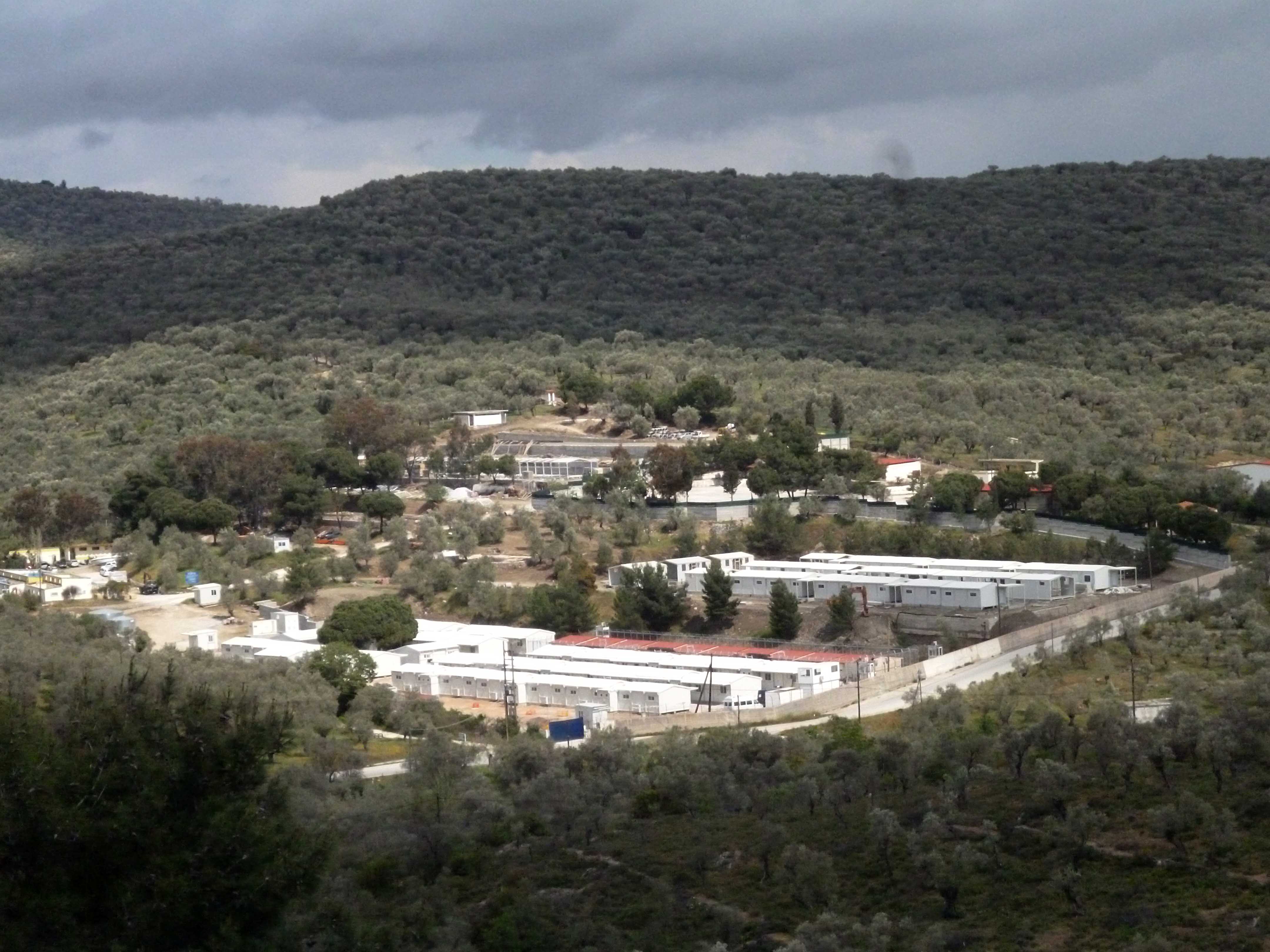
Moria in April 2014 while the construction of the fences was not yet finished
We asked refugees having passed through Moria prison one single question:
‘What was your worst experience inside Moria detention?’
The Syrian who was hit
He was a newcomer. He came from war in Syria. He had no information on how the camp functions. Three times a day the police called all the people to stand in a line in order to count us. At 14.30 to 15 o’clock, all the people had to stand and the police counted. No one was allowed to be missing. When the police entered the container they found him sleeping. One policeman pulled him from the bed, screamed at him and hit him. This guy just didn’t know he had to go out for counting. No one had told him, so he was not guilty. It was not his fault.
Seeking democracy and finding police
When we migrate to Europe we are in search of democracy seeking humanity. We don’t come here to be insulted or treated in badly as if we were guilty or criminals. We have enough of this in our countries: Enough worries, enough dictators, enough people who suffer and enough bad people hitting us.
All of us, who were in the camp at that day, didn’t get food because they were angry about why we were brought there. What we heard about Europe is one thing, and what we face is another thing. The first thing we had to face here was this policeman… But when we got free then we met all these nice people! Wow! Very kind people and very generous people. What we expected, we finally found it!
The man who fell from the bed
He was a short man and the upper bed was high. There was no ladder to climb up. There were no ladders at all in this prison for the beds. Only the first
10 days we had some. Then they took them all off.
His friends had to help him to get on his bed. One night when the policeman shouted us to come to count us, he was asleep. He wanted to get down fast because he was scared that the policeman would hit him, if he wouldn’t be fast in the queue. So he fell down from the bed. For one moment, he didn’t know where he was, because he got so scared in his sleep hearing the policeman scream. He hurt his leg and his back. An old problem he had on his back got worse after that. He told the doctor who said he shouldn’t worry, but still his back hurts. We asked the policemen why they took the ladders away. They said: “So that you don’t escape.”
No shoes
The worst thing in Moria was that I had no shoes. I always asked for shoes but nobody gave me some.
No freedom
Each day of the 25 days in there was horrible for us because we had no freedom. These policemen were all the time disturbing us.
No protection
When the officer hit the Syrian we got scared seeing that such a thing is possible in Europe. In our countries we had learned that Europe is the mother of freedom but we had to understand that there is no protection for us even here. We didn’t come to Europe to be hit, insulted, to be slaves or prisoners.
Greek Guantanamo
The first day we were brought to this prison we were ordered to sit on the ground in a line. The officers forbid us to talk. It was like in Guatanamo. We were prisoners. In there things happen that are not right.
The long walk and standing in the queue
For me the worse was when we walked upon arriving on Lesvos all the way until Moria. No one arrested us to bring us to prison. We had to come ourselves after an exhausting journey.
Inside Moria the worst thing was that they ordered us to stand in a line and punished the ones who didn’t come immediately by not giving them food.
Punishment for praying: no food
When I was once praying and as I finished I went to the queue, but the policeman told me to get out. Everyone got food apart from me. The officer said to me: “You don’t get food today!” On that day I didn’t eat anything.
Prisoners not refugees
The policeman called me to translate for the ones who couldn’t speak neither English nor Greek. He started: “Tell the prisoners…” but before he finished his sentence, I interrupted him, saying: “Excuse me, but we are not prisoners, we are refugees who just arrived from Turkey. We are not prisoners!” The policeman replied: “You are not refugees you are prisoners! Now translate and don’t talk.”
Not allowed to take medicine
When I was in Moria I couldn’t sleep at all. I had problems. I told it to the doctor and she gave me some pills to sleep. At that point I hadn’t slept for four days. The pills helped me finally sleep.
One day I was still sleeping when the policeman came. He said: “If you don’t come on time I will make problems for you.” He forbade me to use the pills again that had helped me to sleep.
When the doctor later asked me how it was going with the pills I told him that I couldn’t use them because the policeman forbid it to me.
Punishment: no electricity
One young boy went out of his container to sit and smoke. The policeman yelled at him to go inside otherwise they would cut the electricity. Then they cut the electricity.
They also cut the electricity of the Syrian woman and minors who were on hunger strike, because they were kept in detention so long despite being Syrians.
Prisoners
In the bathroom there is a sign that says: The ‘prisoners’ ….
Changing rooms
We were in the same room for 23 days. We kept it clean and lived in there.
One day at one o’clock at night they made us change the room, saying new
Afghans came and we should go to another room.
I told them: “We are here already 23 days. We only have two days left until we leave. We want to stay in our room which we kept always nice and clean.” The policeman replied: “I am not your father. Don’t argue with me.” So we had to change the room in the middle of the night and the other room was in a very bad condition. The water of the toilets was running in the room. It smelled, the beds were very dirty and wet. This room was Nr. 7.
Sewage water running in the rooms
The toilet water was running in the rooms Nr. 2 and 7 and also Nr. 5 even though the rooms are new. How will it look in six months if its is like this while its new?
Racist behaviour
All the days were horrible, but even worse was the moment were the Congolese man was at the queue to take his meal and the policeman told him: “You have taken already before. You came to Greece only for food.” He said that loud so that everyone could hear it. He wanted to insult him in front of everyone. At the end he gave him food.
Punishment after the unexpected visit of activists
When the visitors left, our situation got worse. The policemen were very angry. They were screaming at each other. Then they changed the laws. They counted us outside. If we were not immediately out for the counting, we didn’t get food. Before the visit, they wrote on all papers ‘refugees’, after they wrote
‘prisoners’.
A few days later they brought this policeman who was so bad. The one who did all these bad things. Before everything was quiet. Before people were freed after 15 days. After he came the detention duration got 25 days.
NGOs without power
Inside the prison there are NGOs but they have no power to do anything. So why are they there?
No human rights in Greece
When I arrived in Greece I didn’t see any respect of the human rights.
Translators only for one side
We were not allowed to be heard. They say because you arrived without papers you have no rights. The translator when we wanted to say something said: “We can not translate your words. I have to take a permission to do that. I am only allowed to translate what they tell you.” For me this is not a translator. A real translator has to translate in both directions. They should also translate what we say.

Narrow space
The containers we stayed in were very narrow with nothing in it. Not even the children had somewhere to play. Nothing there to change your mind. That you don’t think anymore all the time that you are in prison.
18 months prison
When a person comes here as a refugee without having seen Greece before they put him for 18 months in prison without any reason. It is the worst punishment without reasons. Each person leaves his country for severe reasons. We flee and when we arrive in Europe they put us in prison while the family is left behind. When we heard we might stay 18 months in prison… We lost hope. The ones we left back wait that we arrive somewhere, start new lives and support them. They don’t expect that we go for 18 months in prison without any reason. That’s the worst we heard here.
Freedom stolen
The worst is to take away your freedom and put you prison. While you have no right to talk, nothing. Here you are put in jail with the same problem like in Afghanistan. That makes you crazy. No understanding for our reasons to escape from home. No open arms. No protection. No possibility to forget the past. No one listening.
Nothing to do
Inside the prison there is nothing to do to make the time pass. There are no books or anything. We had nothing. We were just sitting and thinking about our problems in Afghanistan. About being in prison. Our psychological situation got worse day by day. We were all just sitting and thinking what will happen. We only had one ball. The ball was our only help to stop thinking. But the place was to narrow. 30 days in prison we had nothing to do. So the whole time you think. You just think. You are in terrible psychological condition. When the ball fell out of the fence once, the police didn’t give it back for 5-6 hours the police didn’t give it back to us. Then we had again nothing to change our minds. Then we changed the game. We played volleyball instead of football so that the ball didn’t fly over the fence anymore so often. We made a new rule: The one who kicks the ball out of the fence shouldn’t play anymore for 2 days.
Punishment for taking a shower: no food and collecting cigarette butts
The worst day was when I wanted to take a shower and then there was the time for food. I couldn’t get out of the shower fast enough so the police forbid me to get my meal. Although I had managed to arrive in time the policeman said: “Go to the side.” Everybody got food except me. I was the last. Then the policeman said: “You get punished because you didn’t come on time. You will collect all the cigarette butts from the ground, only then I will give you food.” I didn’t do what the policeman told me. I told him I don’t want food; I don’t want to collect the cigarette butts. My dignity is more valuable than one meal.
Old woman punished
There was an old refuge woman. She was a 70 years old Afghan. We had a lot of psychological problems there, being imprisoned on so little space – men and women. That old woman could not stand, so she needed a chair to sit at the queue to get her meal. The policeman kicked the chair and said: “No, you can’t sit, you have to stand!”
Hunger strikers transferred to a ‘18 month prison’
At some point we noticed that Syrian refugees were released sooner while we had to stay in prison. There was an Afghan couple, which stayed 30 days there. We saw them being 30 days there and we got scared we might stay also that long. We did a hunger strike to get free. We were too long in prison. We have problems in our countries. The police told us, if we wouldn’t stop the hunger strike they would put us in prison so we got afraid and stopped the hunger strike. We thought, it is less bad to stay 5-6 days longer here than 18 months in another prison. Then the police came at 18 o’clock in the afternoon. They chose 20 of us. They read the names and told the ones chosen they should get prepared to get free. We were so happy for them at first but then they were transferred and the next morning they called and said they were in ‘a prison for 18 months’. They took them with handcuffs. We got very scared that they might take us too, but we probably were just more lucky so they let us free. This is not a first reception. It is a prison.
No money
Other people ordered something at the shop in Panagiouda but I couldn’t buy anything for my child. She was asking me all the time. I was hiding myself so that she couldn’t see me and ask again until they left. She couldn’t eat the food in prison. The police said if you want something else we call and order. But we had no money.
Asylum only under the precondition of longer detention
I escaped from my country because my life was in danger. I wanted to apply for asylum in Europe and seek protection. When we arrived in Moria one officer explained to us that the ones who would ask for asylum would not be released after one month but be kept longer. Everybody got afraid of asking for asylum then.
Body controls, yelling and throwing away our belongings
The first day they caught us the police behaved very bad, they yelled at us. They brought us to a forest and body searched us. We got very scared because we thought they’d send us back to Turkey. The officers were in plain clothes. A small child ran away. They caught and hit him. Then they put us in a car while still yelling at us. In the car my daughter fell asleep and they still screamed and woke her up. She got so scared that she woke up and hit her head on the window. Then they brought us to Moria. Everything we had with us they threw it in the garbage. We had spent money to buy it and they just threw it away. We all complained and said we needed our belongings. The police chief shouted on us to not talk! There was one officer in the beginning when we arrived. He left after a few days. He was short, had a beard and he was screaming a lot.
I have a question: Why do the police behave to us like criminals? Why do they put us in prison? I have never been in prison before. They tell us: “Open your laces and take them off. Take off the belt.” So, I said we are in prison. These are things they make in prisons. Why did they body search us? I am refugee. I don’t carry drugs. Why did they keep us so long? If they want to check our fingerprints they can do it in one two days. Why 14 days in prison? Why did they make such laws? Why do they give a paper to leave the country in one month? How can we leave if we don’t have ravel documents? The only way is illegally. They dot give us a visa or a passport to go.
Pushed back, stolen belongings
The coast guard took our money, the mobile phones, our rings and watches and pushed us back to Turkey. Everyone had 300-1.000 dollars. The Greeks took everything. Then they pushed them back to Turkey. There where two women in prison in Turkey that said they had beaten them when they pushed them back. They also pushed back a family that is in Moria. They have four children and they are still in Moria. One woman that got scared and started screaming, they hit her. The faces of everyone were full of blood. Why they do that to refugees? The minor they beat him and then they were yelling at us, because he had tried to escape.
Not allowed to sit in the police car
In the police car everybody had to stand although there was space to sit but the police didn’t allow even the women to sit.
Wet sleeping rooms from sewage water
It is not clean in Moria. The sewage water is running in the rooms we sleep. From 14 o’clock when we arrived until 24 o’clock they kept us outside in the cold. We had not done anything wrong. There was no reason for leaving us in the cold, body searching us three times a day or putting us in a line to count us. No one would escape from there even if they would leave the doors open. Until 4 o’clock in the night when we slept, they came in the rooms with torches and checked if someone left. We have heard in Turkey if you don’t get a paper from prison and they catch you in Athens they deport you back. That’s why nobody would escape before getting the paper. Some Syrian woman made a hunger strike because they kept her so long. If you go to the toilet or shower and come one minute too late the police would punish us. It was very cold inside in the prison. The taps were broken. There were a lot of flies. There was only once a day hot water. If one would use more hot water they’d punish you by turning off the electricity for 1-2 days. They wouldn’t even punish the one who had done something they thought wrong. They’d punish anyone.
Confusing information
The first day we arrived they told us the papers we would get were for 30 days. After that we would have to leave from Greece. We asked about the fingerprints if they would be recognized in other countries and they told us yes and then they said, we would be send back to Greece in any case due to the fingerprints.
Body search naked in the police container
The body search where they made us undress took place in room 3, the one of the police. First two policemen took one person in the room, then the women. Rings, watches… Everything: the belts, shoe laces… even my bag, which had laces they cut them with sizzors. A 15-year-old boy was a friend. They brought him inside. He said: “I have no underwear.” They said: “We don’t care: undress!” It was the day we arrived. We were terribly tired but they didn’t care.
Nothing to play with
Our small daughter was all days very sad because there was nothing for children to play. It is a prison. Not even some toys…
Police entering the sleeping space of women at any time
The worst was that all of a sudden in the middle of the night, without even knocking on the door, the policeman came in the container we were sleeping to count us! This scared us a lot: My mother, my sisters and me. We felt there is no respect there.
The dirty, narrow space and cold
There was a problem with the pipes. The water was flowing in the room, leaking from the bathroom. I thought I was again in the sea. There was also not enough space. It was cold. There was no heating. They installed devices but they were not connected.
Aggressive police
The police don’t treat people well. The policemen want to make us feel we are detained. We cannot go out, there is a wall. The police do not let people talk and they talk to us in a bad and aggressive way, especially when they bring us into the rooms at night. They speak to us very loud. Just when you see their faces, their tone, you see that they are threatening you.
Waiting outside and not enough beds
When we arrived in the camp, the police let us wait outside for three hours. It was very cold. It was bad. After, we entered in the place and they told us to find beds. There were not. We had to either sleep together in one bed or on the floor.
From one prison to the other
We were detained by Bashar al-Assad. We escaped from Syria, which was like a jail for us and now we are in another prison! It’s like in the poem of Paul Eduard: Freedom, freedom, I write your name.
Police with two faces
Greek police is very bad. If there is UNHCR in a camp, the police become better. They try to show they are better but actually they are not.
Syrian in detention
Five days, it’s too much time for a paper.
No one asking how we are
I want to say thank you that you are here for us. It is the first Time, that we meet someone in Greece who is asking us: “How are you?” For me it is very important that you just came and asked me how I feel. I thank you for this.
In Mytilene the example of the in solidarity self-organised reception center PIKPA has proven that open welcome centers are possible.
No prisons!
Freedom of movement!
W2EU

Read the text here in Greek

Freitag, 27. Juni 2014
Time to end the EU’s left-to-die policy
http://opendemocracy.net/can-europe-make-it/charles-heller-lorenzo-pezzani/time-to-end-eu’s-lefttodie-policy
Two years ago, we published a report on what came to be known as the “left-to-die” boat case. Co-authored with the architectural office SITU Studio, the report used imaging, mapping, and modelling technologies in order to produce a visual and spatial picture of how, in March 2011, sixty-three migrants lost their lives in the Central Mediterranean while attempting to reach the small Italian island of Lampedusa from the coast of Libya.
The passengers of the “left-to-die” boat were amongst the over 27,000 people who fled Libya towards European shores (over 1,000,000 people fled to neighbouring countries in North Africa) after the beginning of the uprising against Gaddafi and the following international military intervention. These crossings occurred in particularly precarious conditions – with the Gaddafi regime playing an active role in forcing migrants onto boats without regard for even the minimal safety measures. As a result, over 1.500 deaths were recorded among them, one of the all-time highs. These deaths however occurred at a time when the militarization and surveillance of the EU’s maritime frontier was at its apex. The usual assets of national border police from both sides of the Mediterranean, were reinforced by over forty military ships and many patrol aircrafts deployed by western states off the Libyan coast in support of the NATO-led international military intervention. This placed these deaths squarely in the most highly surveyed waters in the entire world, and there were strong indications that military forces were failing in their obligation to rescue migrants in distress, despite possessing the requisite means of surveillance to witness their plight.
The initial testimonies of the nine survivors of the “left-to-die” boat case provided a devastating indictment of this deadly inaction: they claimed that they were left to drift for 14 days in the area monitored by NATO, despite sending a distress call as well as encountering at least one military helicopter and a military ship. With the aim of identifying direct responsibility for these deaths, a loosely associated network of journalists, NGOs and institutions such as the Council of Europe launched parallel investigations on the case.
In support of this endeavour, our report corroborated the survivors testimonies with a wide range of digital mapping and remote sensing technologies – from drift modelling to determine the trajectory of the drifting migrants’ boat to satellite radar imagery to detect military vessels in proximity.
As narrated in the video animation that we release today, by using surveillance technologies against the grain, we were able to read the traces left on the surface of the sea. Turning the ocean itself into a witness for interrogation, we reconstructed and mapped as accurately as possible what happened to this vessel.
Liquid Traces: The Left-to-Die Boat Case, Charles Heller and Lorenzo Pezzani, 17 min, 2014. Animation produced for the exhibition “Forensis”,
While none of the parallel investigations on this case was able to determine the identity of the helicopter and vessels that entered into direct contact with the migrants in distress, they all concurred that the account of the survivors was highly accurate. In our report, we established with certainty that the Italian and Maltese Maritime Rescue Coordination Centres, as well as NATO command, were informed of the location and distress of the migrants, and that there were several naval assets in the vicinity of the boat that had the ability to detect and assist it, but that none of these actors intervened in a way that could have averted the 63 deaths. The collective failure to assist the passengers amounted to murdering them without touching their bodies, turning the winds and currents into a deadly weapon.
On the basis of our report and the other investigations, a coalition of NGOs has filed legal cases against several of the states participating in the military operations in Libya, including Italy, France, Spain and Belgium, and submitted Freedom of Information requests in Canada, the US, and the UK. The Dutch Senator Tineke Strik also sent, on behalf of the Council of Europe, official demands to all actors involved to ask for further details about their (in)actions.
In the process, no element either of our or the other reconstructions has been disproved. No public statement, no journalistic investigation, no legal inquiry has even tried to challenge the facts as we have reconstructed them. On the contrary, a French judge reviewing the case lauded the, “exhaustive investigations by prestigious international bodies”, before using the rigour of our inquiry to justify her refusal to investigate the case any further, claiming, on the unique basis of the (non)answer by the French military (i.e., the accused), that French assets were not deployed in the area.
This pattern has repeated itself in all the different procedures. As Strik summarizes in her recent follow up report:
“I received denials, referrals back to NATO and/or the member states, or, in some cases, no answer at all. (…) Legal cases and Freedom of Information applications are being pursued in a number of the member states implicated but seemingly in vain.”
In tortuous diplomatic non-answers (of which the correspondence contained in Strik’s follow up report provides a striking example), NATO and participating states have failed to provide exhaustive answers to simple questions such as the location of their assets during the time of the events (which are certainly meticulously recorded in their assets’ log books) or justify their (non) response to the distress call. Neither have they sought to disprove the allegation of the survivors that they were visited twice by a military helicopter and encountered a large military ship. It is as if the huge military surveillance apparatus that refused to see and react to the slow death of the 63 passengers over a period of 15 days had now itself become invisible to public scrutiny. While fully visible to the public, the collective crime of which the passengers have been the victims has remained invisible to the law.
 In the production of report, satellite imagery was crucial in confirming the presence of a high number of ships in close proximity of the drifting migrants’ boat. Pictured here Envisat-1 Synthetic Aperture Radar (SAR) satellite image for 29 March 2011 with corresponding table of returns documenting estimated length of vessel and confidence. Analysis by Lawrence Fox III, Humboldt State University Emeritus Professor of Remote Sensing, for the Forensic Oceanography report. See larger version.
As a result of the lack of response and legal inquiry, not a single actor has been made responsible for the deaths of the 63 passengers. The indifference which led to their being abandoned to the winds and currents, continues to plague the demand for justice of the survivors, perpetuating their drift even on firm land. Such a continued impunity sends out the message to all actors operating at sea that migrants can be abandoned to their deaths with no consequence. And in effect, similar incidents have repeated this since.
The mechanism of death by policy: illegalisation, militarisation and non-assistance
 Deaths at the Borders of Europe. Source: Migreurop, Atlas of Migration in Europe: A Critical Geography of Migration Policies (London: New Interna- tionalist Publications, 2013). See larger version.
In her June 2014 follow-up report, Strik notes importantly that several recent incidents – including two of them that occurred near Lampedusa on October 3and 11, causing the death of more than 550 people - demonstrate not only that justice has not been dellivered to the survivors of the left-to-die boat case, but that no lessons have been learned from it. The October 11, 2013 shipwreck, which we have jointly documented with the WatchTheMed network, effectively seems in many ways the tragic repetition of the left-to-die case: a boat carrying more than 400 people started taking in water after it was shot by a Libyan vessel. Despite the Italian and Maltese coast guard being warned of the imminent distress of the passengers, rescue was delayed for over 5 hours and patrol vessels arrived only 1h after the boat had sunk and more than 200 people had died.
If this is the last case of migrants’ death being caused by the failure to assist them when in distress, several other incidents related to different causes have continued to prolong the list of close to 15.000 documented deaths at the EU’s maritime borders over the last 20 years. As the very periodiziation of these deaths makes evident – the count starts at the end of the 80s, when visa restrictions were imposed by EU states towards the non-Europeans and the first bodies of migrants washed away on European shores – these are less “tragedies” than deaths by policy, produced by the combined mechanisms of illegalisation, militarisation and refusal to assist.
The initial denial of visas to access the EU’s territory produces ripple effects throughout global space, with bordering practices enforced by or on behalf of the EU extending ever further within and without EU territory, thereby precaritizing non-European migrants’ entire trajectory. As they arrive on the southern Mediterranean shore, they are forced to resort to dangerous means of crossing and rely on smuggling networks, which usually provide boats in poor condition, overload them to maximize their profit, and offer only minimal - if any - security measures. While one should not deny the responsibility of smugglers and authorities that allow them to operate - without the EU’s policy of illegalisation, migrants would not resort to them.
Secondly, in order to detect and intercept illegalized migrants, border patrols and surveillance means were deployed by EU member states. Frontex (the European border agency), as well as states located on the southern shore of the Mediterranean were put under pressure by the EU, thus effectively turning the Mediterranean into a vast frontier zone. This militarization on the one hand leads to repeated acts of direct physical violence by border guards – such as shootings, collisions, and punctured boats, but also push-backs - which are not only illegal according to international law but may involve the use of violence as has recently been the case in Greece recently. But the most deadly effect of militarisation is less direct. In the attempt to evade border guards and avoid being intercepted, deported and violated, migrants use longer and more perilous routes, which cost more lives. Over the last 20 years, the militarisation of the EU’s maritime frontier has thus not succeeded in stopping illegalised crossings, but has caused the splintering of trajectories to more dangerous routes.
Finally, as a consequence of the very precarious condition that migrants are forced to resort to, they regularly encounter situations of distress – with failing motors, water entering the boat or loss of direction - and call on the rescue agencies operating in the area or the many vessels transiting in the Mediterranean for help. Nevertheless, because rescuing migrants at sea entails taking responsibility for the processing of the asylum requests or for their deportation, coastal states have grown increasingly reluctant to assist migrants in distress. While international conventions on the Laws of the Sea have sought to ensure the responsibility to rescue passengers in distress regardless of nationality or status, coastal states use overlapping Search and Rescue areas, conflicting conventions and differing interpretation of international law to evade their responsibility.
Furthermore, the criminalisation of assistance by states – fisherman for example have been put on trial for “assisting clandestine migration” after rescuing migrants – has also been a disincentive for seafarers to comply with their obligation to provide assistance. Here too then, while one should in no way diminish the responsibility of specific actors for practices of non-assistance – fishermen, commercial ships, or, as we have seen in the left-to-die boat case, the military and coast guard itself - it is clear that their behaviour is framed by the EU’s migration policy of generalised reluctance to accept non-European migrants and refugees on its territory. As such, cases of non-assistance are not “accidents” or simply the product of malevolent actors, but rather occur on a structural basis.
Governed by a partial and deterritorialised sovereignty regime which enables EU states and agencies to selectively expand their elastic bordering practices or retract from their responsibility to assist passengers in distress, the Mediterranean Sea has thus become a space of deeply hierarchised and segmented mobility: speedy and secure for certain goods and privileged passengers, slow and deadly for the unwanted. This regime produces deaths on a large scale far from any civilian gaze. This loss of life remains largely unaccounted for and – with most bodies remaining unidentified in their liquid grave – unmournable.
Post October 3: intensified militarisation under a humantitarian varnish
The public outcry that followed the death of more than 550 people in two successive shipwrecks in early October 2013 seemed, for a fleeting moment, to indicate that suddenly a realisation of the deadly effects of the EU’s migration policy was emerging, and that a window of opportunity to rethink another policy had been opened at the cost of these lives.
However, instead of questioning the very migration policies which had produced those and the previous deaths, the EU took what it called a “tragedy” as an opportunity to increase surveillance and militarisation, albeit under a humanitarian varnish: North African states were urged once again to prevent migrants from leaving their shores; Frontex, the European border agency, was called upon to extend its operations to the whole Mediterranean and received extra funding to this effect; a new surveillance tool which had long been in development - Eurosur, the European Border Surveillance System – was launched with the claim that it would help prevent deaths; finally, a large scale operation – Mare Nostrum – , defined by the Italian Ministry of Defence as a “humanitarian operation, […] as well as a security one”, was launched by the Italian government. However, the claims of these “new” initiatives to save lives are dubious at best and rather show how humanitarian arguments have themselves been enlisted within the same logic of closure and militarisation that, as we have argued, is the root cause of death and violence at the border.
The claim of the proponents of Eurosur that while current surveillance technologies have difficulty detecting small boats used by migrants, Eurosur will be able to do so through cutting-edge remote sensing technologies – such as drones, radars, and satellites – does not withstand the test. On the one hand, the cases of the left-to-die boat and of the 11 October 2013 blatantly demonstrate that it is not enough to detect boats in distress to save lives. On the contrary, migrants are regularly abandoned in all knowledge of their fate. Furthermore, although Eurosur was launched in December 2013, concurring with many critical assessments including our own, Frontex has recently admitted that Eurosur does not have the capacity to date to detect migrants’ numerous small boats in such as vast maritime area.
As for the operation Mare Nostrum, it has not been able to put an end to deaths at sea, despite the deployment of 6 Navy ships as well as several aerial assets, including unmanned drones. Since the start of the operation, the number of crossings have intensified. While over 50.000 people have been saved since the beginning of the year, (among which are many Syrians families fleeing the civil war) several shipwrecks happened in the last weekscosting the lives of tens of people have shown once again that no surveillance apparatus will ever be able to avoid these deaths. Instead, what Mare Nostrum has achieved, has been to transform rescue at sea into border enforcement operations that expedite deportation of certain migrants, while slowing down the mobility of others who are stranded in the camps of southern Italy with no further assistance.
As such, we see that the new operational measures implemented by the EU in the aftermath of the October 2013 “tragedies” are far from offering an alternative the continuing deaths of migrants at sea, and rather represent a continuation of the very practices that have caused them in the first place.
On the policy level, the response so far leaves little more hope. A“Mediterranean Task Force” was created by the EU Commission, which made a number of proposals to the December 2013 EU Council meeting. These were already mostly geared towards strengthening border controls, but the little humanitarian provisions they contained – such as increasing resettlement of refugees and opening further possibilities for asylum applications to EU member states from outside the EU - were thrown out by the Council in December and would in any case have been insufficient to put an end to the death of migrants at sea. Neither further strengthening border controls, nor even the desirable guarantee of further compliance with human rights will bring the death of migrants to an end, for these deaths have, as their root cause, the denial of legal access to non-European migrants. Short of lifting this ban, these deaths will continue.
Challenging the closure of borders
In the month prior to the EU Council’s meeting of the 26-27 June which will address long term European migration policy groups of activists have been performing collective acts of transgression of the EU borders. A transnationalRefugee March, composed to a large extent by asylum seekers, refugees and undocumented migrants has been travelling from Strasbourg to Brussels, ignoring the restrictions on movements imposed on them, to demand an end to the policies of border closure. It has been joined by caravans of migrants and activists from Italy who, on board of a no border train have been following the routes that migrants rescued in the Mediterranean are usually forced to take in hiding on their way to other European countries. European nationals, migrants, refugees have challenged together the rhetoric of Europe as a space of “free circulation” and questioned their very division into different categories of people, some of which can move, some who cannot. They demand not only freedom but also equality of movement.
In performing collectively and publicly the transgression of the EU’s internal borders, they also echo the every-day clandestine crossings of all the other extended external borders of the EU – which, in practice, extend from the Sahara to the Mediterranean, passing by the fences of Ceuta and Melilla. Together, they remind us that human beings are essentially free in their spatial mobility, which persists independently of any attempt to govern them.
Despite this daily reality of movement across borders, demands for freedom of movement and the right to a safe, legal access to European territory have often been portrayed as a distant, unrealistic utopia imagined by a handful of dreamers. But don’t more than 20 years of continued illegalised migration and deaths at the EU’s borders amply demonstrate that what is utterly unrealistic is in fact the banning of non-EU migrants and the attempt to stem their mobility? The reality is that the number of deaths at the borders of Europe has augmented under the effects of militarization and will continue to rise short of anything less than a radical opening of our political imagination towards freedom of movement.
The actual movement of migrants point towards such a horizon, as do the collective demands of migrants’ rights organisations recently expressed in theLampedusa Charter or through the joint call of the Migreurop network. Scholars have also explored what the recognition of a Right to Mobility might entail.
Certainly, a first incentive for such a reorientation to take place would be to make EU states and policymakers accountable for their (in)actions and the consequences of their practices that produce deaths on a large scale. Rather than an exceptional event, the story of the “left-to-die” boat narrated in our video is just one of the many examples of deaths by policy. This is why, beyond individual responsibilities, bringing justice to the passengers of the “left-to-die” boat would be a modest but fundamental step towards another Europe.

This article is published under a Creative Commons Attribution-NonCommercial 3.0 licence. If you have any queries about republishing please contact us. Please check individual images for licensing details.
Freitag, 20. Juni 2014
Unterschreiben und weiterleiten
MANIFEST FÜR LAMPEDUSA IN HAMBURG -MANIFESTE POUR LAMPEDUSA À HAMBOURG | www.manifest-fuer-lampedusa-hh.de/ | Mail: lampedusa-hh-manifest@gmx.de
|
Es muss sich etwas ändern an der Haltung des Hamburger Senats: Mit einem gemeinsam unterzeichneten Manifest stellen sich erneut und über die Stadtgrenzen hinaus Personen und Institutionen an die Seite der afrikanischen Flüchtlinge, die in Libyen gearbeitet haben, 2011 vor dem Krieg über das Mittelmeer nach Lampedusa geflüchtet sind und hier seit über einem Jahr für ihre Rechte kämpfen: "Wir unterstützen den Kampf dieser Gruppe, aus den unter-schiedlichsten Gründen. Die einen sind aus christlicher Nächstenliebe dabei, andere aus humanitären oder politischen Gründen, manche sind als Nachbarin oder Nachbar dazu gekommen, andere von uns vertreten soziale, kulturelle oder politische Institutionen. Was uns eint, ist die Überzeugung, dass diese Menschen eine Zukunft haben müssen – und zwar hier, in dieser Stadt (...)."
Montag, 16. Juni 2014
Demonstration 5. Juli 2014: Anerkennung der Gruppe ‚Lampedusa in Hamburg’ – jetzt!
Über
1 Jahr Kampf sind genug – wir wollen ‚Lampedusa in Hamburg’ als Freund_innen,
Kolleg_innen, Kommiliton_innen, Nachbar_innen!!
Demonstration 5. Juli
2014 – 12.00 Hachmannplatz, HH-Hauptbahnhof zum Lampedusa in Hamburg-Haus
Anerkennung
der Gruppe ‚Lampedusa in Hamburg’ – jetzt!
Sofortige
Arbeitserlaubnis – Bleiberecht z.B. nach
§23
Dafür kämpft die Gruppe ‚Lampedusa in
Hamburg’ seit über 1 Jahr mit unzähligen Veranstaltungen, Besuchen von Schulen,
Universitäten, Nachbarschaftsversammlungen, Kirchen, mit Demonstrationen und
anderen Aktionen, zuletzt mit einem Sitzstreik auf dem Rathausmarkt, bei dem
durch brutale Polizeiangriffe 5 Menschen verletzt und 7 festgenommen wurden. Dafür
haben wir zusammen am 1. Mai in der DGB-Demo und in einer Parade demonstriert,
nach der eine ehemalige Schule in der Laeiszstraße zum Refugee Welcome Center
erklärt wurde, dem Lampedusa in Hamburg Haus.
Deklaration
der Gruppe Lampedusa in Hamburg, 6/2014
LAMPEDUSA IN
HAMBURG HAUS
> Wir, Lampedusa in Hamburg, wollen das Haus zu
einem historischen Ort machen.
> Wir
begreifen das Haus als Symbol für uns Nato-Kriegsflüchtlinge.
> Wir wollen das Haus nutzen, um unsere
professionellen und kreativen Fähigkeiten umzusetzen.
> Wir wollen das Haus als Schule nutzen, z.B.
um die deutsche Sprache zu lernen.
> Das Haus bedeutet für uns die Wahrung
unserer grundlegenden Rechte - wir haben es satt auf der Straße zu leben.
> Wir brauchen das Haus, um unsere Würde zu
schützen.
> Wir brauchen das Haus, um als Familie
zusammen zu bleiben.
> Wir brauchen das Haus, um unseren legitimen
politischen Kampf weiter zu führen.
Heute, nach Auslaufen der
Winternotprogramme, stehen viele Mitglieder der Gruppe ‚Lampedusa in Hamburg’ wieder
auf der Straße dieser Stadt, zu der sie seit über 1 Jahr gehören. Sie haben in verschiedenen
Berufen in Libyen gearbeitet, für ihre Familien in ihren Herkunftsländern
gesorgt, mussten vor den NATO-Bomben fliehen und fanden nach der gefährlichen
Flucht über das Mittelmeer in Italien keine Möglichkeit sich eine Existenz
aufzubauen. Sie wollen in Hamburg leben und wir wollen sie hier. Sie sind Teil
unseres Lebens geworden, sie und wir brauchen dieses Haus. Wir, Freund_innen,
Nachbar_innen, Kolleg_innen, Kommiliton_innen, Unterstützer_innen, Fans werden wieder
und wieder und wieder demonstrieren, bis der Hamburger Senat dies anerkennt.
Hamburg,
13. Juni 2014 / Supportertreffen ‚Lampedusa in HH’
Lampedusa in Hamburg –
they are here to stay!
Sofortige Anerkennung
der von Italien ausgestellten Aufenthalts- und Arbeitserlaubnisse!
Sonntag, 15. Juni 2014
MANIFEST FÜR LAMPEDUSA IN HAMBURG |
Mail: lampedusa-hh-manifest@gmx.de |
Es
muss sich etwas ändern an der Haltung des Hamburger Senats: Mit einem
gemeinsam unterzeichneten Manifest stellen sich erneut und über die
Stadtgrenzen hinaus Personen und Institutionen an die Seite der
afrikanischen Flüchtlinge, die in Libyen gearbeitet haben, 2011 vor dem
Krieg über das Mittelmeer nach Lampedusa geflüchtet sind und hier seit
über einem Jahr für ihre Rechte kämpfen: "Wir
unterstützen den Kampf dieser Gruppe, aus den unter-schiedlichsten
Gründen. Die einen sind aus christlicher Nächstenliebe dabei, andere aus
humanitären oder politischen Gründen, manche sind als Nachbarin oder
Nachbar dazu gekommen, andere von uns vertreten soziale, kulturelle oder
politische Institutionen. Was uns eint, ist die Überzeugung, dass diese
Menschen eine Zukunft haben müssen – und zwar hier, in dieser Stadt
(...)."
Einladung zur PRESSEKONFERENZ
am Montag, d. 16. Juni 2014 um 12 Uhr
beim Infozelt der Gruppe Lampedusa in Hamburg (beim Hauptbahnhof, Steindamm/ Steintorplatz)
HIER EINE ZUKUNFT! MANIFEST FÜR LAMPEDUSA IN HAMBURG
mit den Erstunterzeichnenden
Amelie Deuflhard, Intendantin Kampnagel, Bela B., Musiker und anderen
sowie mit
Christoph Twickel, Siri Keil und Tanja van de Loo als Vertreter_innen der Manifest-Impulsgruppe
und
Asuquo Udo und Ali Ahmad, Sprecher der Gruppe Lampedusa in Hamburg.
:::::::::::::::::::::::::::::::::::::::::::::::::::::::::::::::::::::::::::::::::::::::::::::::::::::::::::::::::::::::::::::::::::::::::::::
Weitere Erstunterzeichnende sind Roger Willemsen, Karin Beier, Dr. Dorothee Bittscheidt, Justus Frantz, Elfriede Jelinek, Jan Delay, Fatih Akin, Esther Bejarano, Jack Kurfess, Dr. Miriam Rürup, Pheline Roggan, Isabel Enzenbach und vielen anderen mehr.
Samstag, 7. Juni 2014


Abonnieren
Posts (Atom)